

Canvas print for your wall: how to choose the right size and place
Share
You have found a beautiful picture. You already know you want it on your wall. But then comes the moment: what size? Which wall? How high?
The wrong size or the wrong place can spoil even a good picture. A print that is too small gets lost on a large wall. One that is too big overwhelms a small room. A print hung too high feels distant, and one hung too low gets in the way.
In this guide we go through practical rules for choosing the size of a canvas print, placing it in different rooms and hanging it correctly. The advice applies to all canvas prints, but a Lapland landscape print in particular comes into its own when it is the right size in the right place.
1. What is a canvas print?
A canvas print is a picture printed on canvas and stretched over a wooden frame. It differs from an ordinary framed picture in important ways: there is no glass, the frame is part of the print, and the canvas folding around the sides gives the picture a three-dimensional depth.
A canvas print is ready to hang straight away: the hanging fixture is already on the back. It is light, durable and suits almost any interior style, from modern Scandinavian homes to more traditional cabins.
The matte canvas does not reflect light, so the picture looks just as good in bright daylight, in the dim evening and in an artificially lit room. This is one reason why the canvas print has risen alongside the framed picture and the poster, and in many homes already past them.
2. How do I choose the right size for a canvas print?
Choosing the size is the single most important decision when buying a canvas print. A print that is too small feels insignificant, one that is too big dominates the room uncomfortably.
A small print: when does it work?
A small canvas print, about 30 x 40 cm or 40 x 60 cm, works best in a confined space or as part of a larger arrangement.
It suits a hallway where the wall space is narrow. Above a bedside table in a bedroom it is perfect: not too dominant, but impressive enough. In a cabin, smaller prints work in the sauna lobby, the stairwell or on a narrow strip of wall.
With a small print you can also test what kind of atmosphere suits the walls of your home before investing in a larger one.
A medium-sized print: the most versatile choice
A size of 50 x 75 cm or 60 x 80 cm is the most versatile option for a canvas print. It is big enough to be impressive, yet still fits most spaces.
This size works above the sofa in a living room, on the head wall of a bedroom or as a mood picture in a dining area. It is most often the size that makes a clear impact in a room without dominating the whole space.
If you are not sure which size suits, a medium size is the safe choice.
A large print: bold and impressive
A large canvas print, 70 x 100 cm or bigger, is a bold choice that pays off in the right place. A Lapland landscape print in a large size is at its best when a perfect fell horizon or a still lake surface spreads across the wall just as it appears in nature.
A large print needs space around it. It needs an open wall surface and enough viewing distance. The end wall of a living room, the back wall of an open-plan kitchen or the end of a spacious hallway are the best places for a large print.
A large print works alone: it does not need other pictures or decorative objects around it. Let it breathe.
Rule of thumb: the ratio of wall to print
A practical guideline: the width of the print should be about 50–75% of the width of the wall space or piece of furniture above which it is hung.
If your sofa is 200 cm wide, the print can be 100–150 cm wide. If you hang a print above an 80 cm wide console table, the print can be about 40–60 cm wide.
This rule applies to a single print. In a gallery of several prints, the size of the whole arrangement is calculated together.
3. Which canvas print suits which room?
Every room is different and every room calls for a different picture. Here is room-by-room advice.
The living room is the print's most important stage
The living room is the heart of the home and the most natural place for a canvas print. A print hung here gets the most glances.
In a living room the print is usually placed above the sofa. Remember to leave about 15–20 cm between the back of the sofa and the lower edge of the print: not too close, but not so far that they feel disconnected from each other.
A Lapland landscape print suits a living room especially well because it brings closeness to nature and calm into the space. A broad panoramic view, a fell horizon or a lake surface, works better in a living room than a detailed close-up.
The colour palette should be matched to the rest of the room. Lapland winter pictures, with their blue, white and grey tones, suit light Scandinavian interiors especially well. The warm ochre browns and oranges of autumn colours work well in a home with wood and natural materials.
The bedroom: calm and atmospheric
The bedroom is the most personal space in a home. Here you choose a picture you want to fall asleep and wake up with.
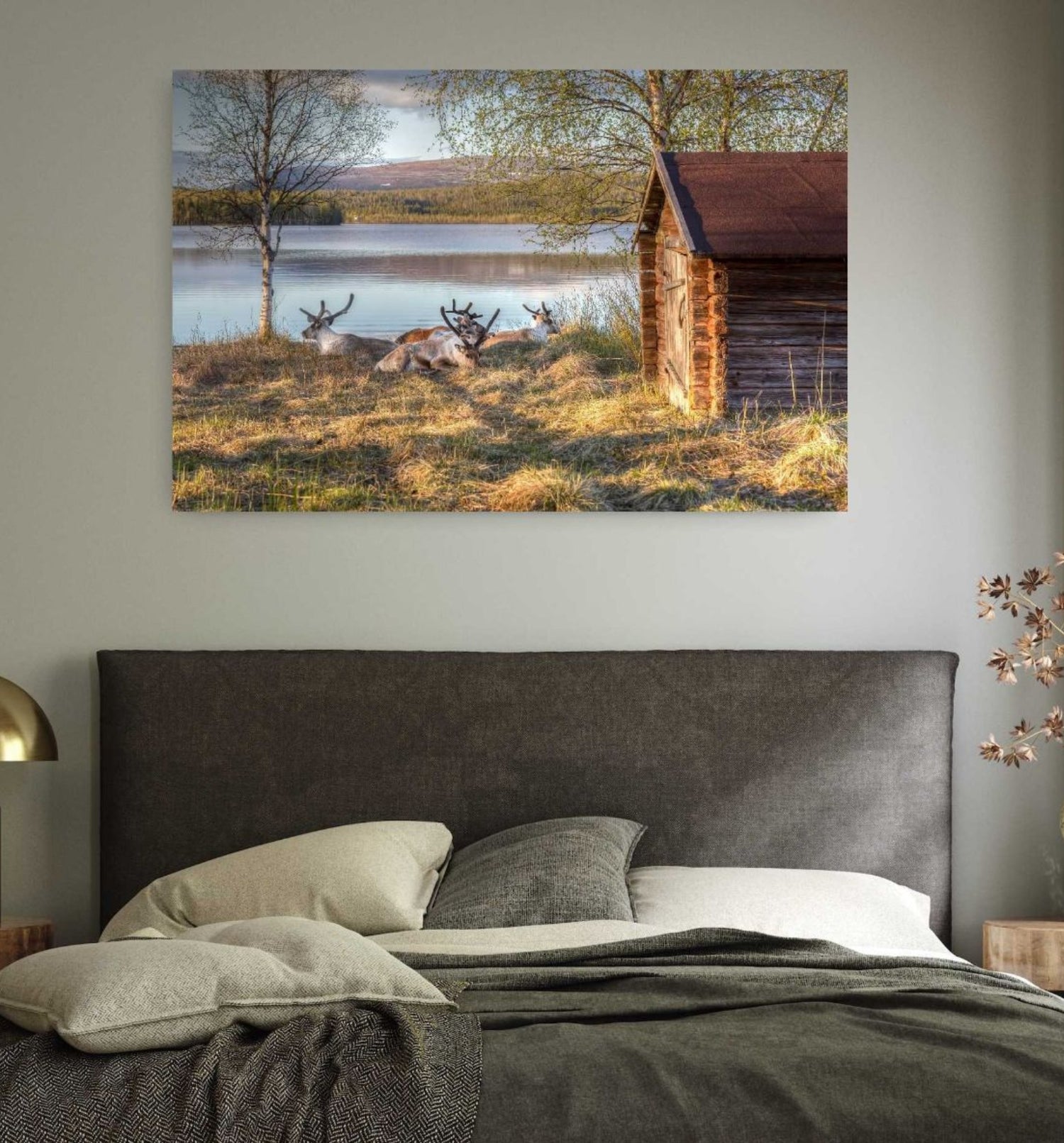
A calm and soft picture suits a bedroom. Not too exciting, not too bright: something that soothes. A still lake surface, a snowy forest or a reindeer resting in the quiet snow are perfect subjects for a bedroom.
The head wall of the bed is the best place for a print in a bedroom. Hang the print at eye level: lying down, about 120–130 cm from the floor to the centre of the print.
In a bedroom you can also try two smaller prints side by side on either side of the bed, above the bedside tables. Finding a matching pair is not always easy, but when it works, the result is balanced and stylish.
The hallway: the first impression counts
The hallway is where a home receives a guest. It is also the first sight when you come home yourself.
A print that is atmospheric but not too large suits a hallway. Hallways are often narrow, so the viewing distance is short. A print that is too big feels cramped.
A vertical print often suits a hallway better than a horizontal one, because hallway walls are often narrow but tall.
A more detailed Lapland subject suits a hallway well: a capercaillie on a branch, a flock of snow buntings or a close-up of a reindeer. When the viewing distance is short, the details come out better.
The kitchen: a surprisingly good place
In many homes the kitchen is an underrated place for a print. But a lot of time is spent in the kitchen, making breakfast, doing housework and drinking coffee, and the right print makes it a nicer place to be.
A smaller print or a narrow vertical format suits a kitchen. Place it so that it does not interfere with practical work: not above the stove and not too close to the sink.
A Lapland summer picture, a lush fell landscape, a flowery meadow or a bog in the sunlight, brings a summery atmosphere to a kitchen all year round.
The cabin: the natural setting for Lapland prints
A cabin is the most natural setting for a canvas print. Cabin walls live: log surfaces, wood panelling or old wallpaper, and a Lapland landscape print suits them all.
At a cabin you do not need to think about the print as precisely as in a city apartment. The atmosphere matters more than exact measurements. A reindeer on the lawn, the northern lights in the sky or an autumn fell: all of these suit a cabin.
Do, however, take moisture into account: a sauna or a wet room is not suitable for canvas prints. Elsewhere in the cabin a print holds up well.
4. How do I hang a canvas print correctly?
The right height and the right technique make hanging easy and the result neat.
The right height on the wall
The most common mistake when hanging a print is hanging it too high. It is an understandable mistake: we stand while we hang and judge the height from a standing position.
A canvas print is hung so that its centre is about 145–160 cm above the floor. This is the natural eye height when standing.
An exception: if the print is hung above a sofa, chest of drawers or console, lower the height so that there is 15–25 cm between the print and the furniture. Then the print and the furniture form a unified whole.
In another exception, when ceilings are especially high, the print can be hung slightly higher, but not so far up that it cannot be viewed comfortably.
One print or a gallery of several?
One large print is a strong choice: it takes the attention and creates a clear focal point.
A gallery wall, with several prints arranged into a unified whole, is another option. A gallery wall suits a long hallway, the wall beside a staircase or a large living room especially well.
When planning a gallery wall, it is worth doing the following:
- Keep the gaps between prints even, about 5–10 cm
- Choose prints that match in mood or colour palette
- Try the layout on the floor first before hanging it on the wall
As a gallery of Lapland prints, four different seasons from the same area work beautifully, or a series of animal pictures combined.
Fixings and weight
A canvas print is light: most often under two kilograms. It needs no special reinforcement and no wall plugs for concrete.
A canvas print has the hanging mechanism ready on the back. Before hanging, check what kind of fixing your print has, and choose the right hook or nail for the wall accordingly.
5. What kind of subject suits which space?
Size and place are important, but the subject creates the atmosphere. A Lapland landscape offers many different options for different spaces.
Calm subjects: the bedroom and resting spaces
Subjects with silence and peace suit a bedroom and other resting spaces. A still lake surface in the evening sun. A snowy forest in the light of early morning. A reindeer sleeping in frosty snow.
These pictures calm: they take your thoughts away from everyday life and invite you to rest.
Strong subjects: the living room and workspace
Slightly stronger subjects that inspire and stir feelings suit a living room and a workspace. The northern lights under a starry sky. Storm clouds over a fell. A capercaillie at its lekking ground in a winter forest.
These pictures tell a story: they give the viewer something to explore and wonder at.
Lapland subjects for the cabin and leisure spaces
Almost any Lapland subject suits a cabin, but especially pictures that depict exactly that area or the activities pursued at the cabin. A lake or a river for an angler's cabin. A fell landscape for a skier's cabin. A wide panorama for a hiker's cabin.
When a picture says something about the life lived at the cabin, it is more than a decorative element: it is part of the cabin's story.
6. Caring for a canvas print and how long it lasts
A quality canvas print needs hardly any care, but a few practical tips will extend its life.
How long does a canvas print last?
A quality canvas print lasts for decades. The canvas is stretched over a wooden frame that keeps its shape as long as changes in humidity are not too extreme. UV-protected ink does not fade in sunlight in the same way as the colours of a paper poster.
In practice a quality canvas print moves with your home: it survives moves, renovations and changes in life.
How do I clean a canvas print?
A canvas print is cleaned simply: wipe it lightly with a dry soft cloth when needed. No abrasives, no solvents, no jet of water.
Dust is worth wiping off a few times a year, especially if the print is in a hallway or near the kitchen. A soft feather duster or a microfibre cloth works best.
Avoid direct sunlight over the long term; not because the ink would fade quickly, but because the canvas can become slightly brittle over decades. This applies to all textiles.
A piece of Lapland for your home
A canvas print that is well chosen and well placed changes the mood of a room: it is not mere decoration but the spiritual anchor of the space. A place the eye returns to. A landscape that says something about the people who live in the home.
A Lapland landscape print is a special choice: behind it is a story, a trek and a moment that cannot be repeated. When it is the right size and in the right place on your wall, it is no longer a picture, it is a window to the north.
Choose the right size and subject for your wall: explore all of LappiArt's prints.